


Kia ora,
Strangles has been a real concern across New Zealand’s horse community this year. If you train, breed, ride or care for horses, a clear clean-down routine is one of the best tools you have. It protects your own horses and the horses you meet at races, sales, shows and pony club days.
Where things stand in New Zealand
- Cases are currently confined to the thoroughbred sector. The New Zealand Equine Health Association’s update of 10 November 2026 reports that the Waikato cluster is largely contained. A small Taranaki cluster has two confirmed cases and eight suspected cases in isolation.
- This strain is new to New Zealand. Typing shows this strain of Streptococcus equi hasn’t been identified here before. Experts believe NZ horses have little immunity to it.
- Vaccine. The equine industry has asked MPI to fast-track registration of a newer overseas vaccine, so that yearlings can be protected before the main yearling sales in the last week of January 2027.
- Strangles is not a notifiable disease in New Zealand. It is endemic here and spreads easily, so early reporting to your vet and open communication still matter.
How it spreads
Strangles spreads through direct contact with infected horses. It also spreads indirectly through contaminated equipment, water, transport vehicles, clothing and handlers. The bacteria can survive for 4–6 weeks in water troughs and for more than a month in dried discharge. Some recovered horses become silent carriers. They look healthy but can still infect others.
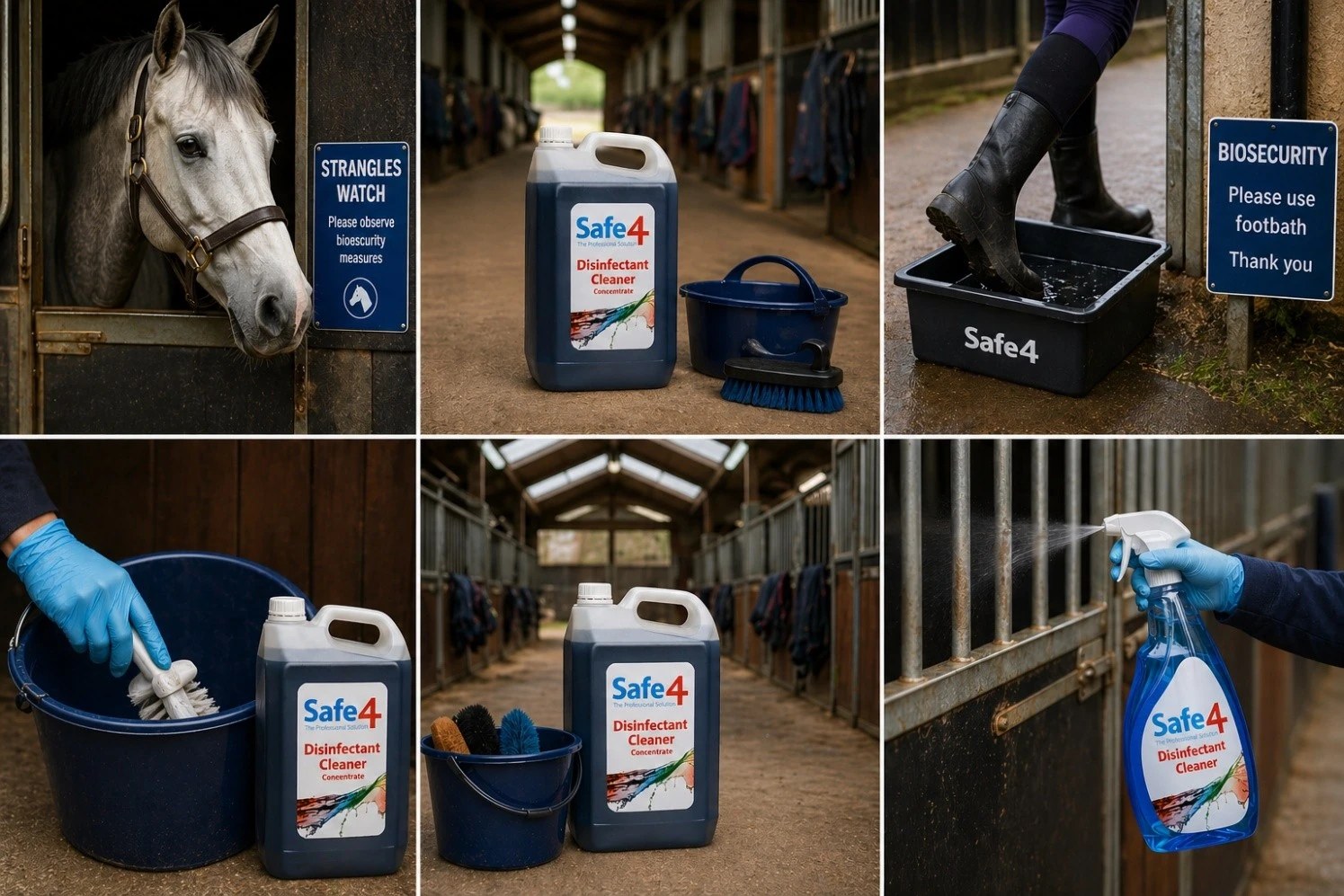
If you suspect strangles
|
1
|
Isolate first, then call your vet. If it looks like strangles, treat it as strangles until a test says otherwise. |
|
2
|
Check temperatures. Fever is often the first sign. Isolate any horse with a temperature above 38.5°C and don’t move it. |
|
3
|
Separate new arrivals. Quarantine new or returning horses for 14–21 days and check their temperatures twice a day before they mix with other horses. |
|
4
|
Split into three groups: infected, exposed and clean. Give each group its own gear and, ideally, its own people. Stop movements on and off the property until your vet gives the all-clear. |
|
5
|
Leave antibiotics to your vet. In most cases good nursing care is the mainstay of treatment. |
The 8-step disinfection plan
This plan can be applied to most facilities, including isolation boxes, recently infected stables, and floats and trucks. Use the same principles to lift biosecurity on your property all year round.
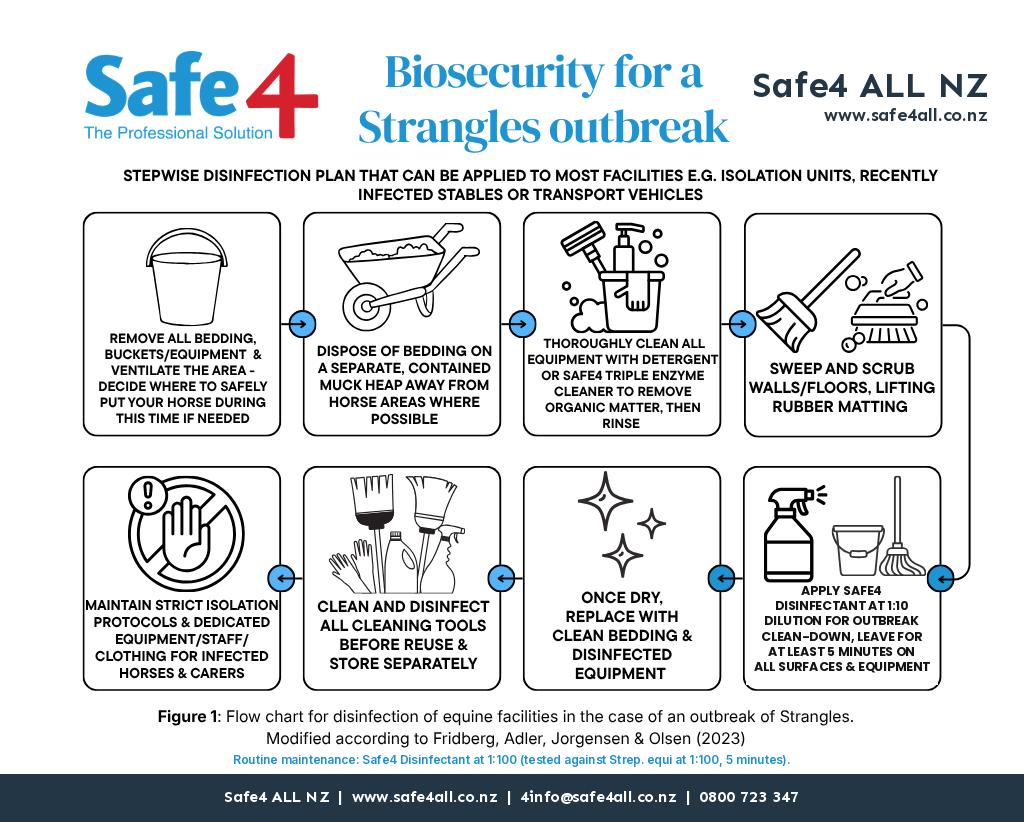
Download the NZ stepwise disinfection plan (PDF)
- Remove and ventilate. Remove all bedding, buckets and equipment, and ventilate the area. Decide where to put your horse safely in the meantime if needed.
- Contain the bedding. Dispose of bedding on a separate, contained muck heap, away from horse areas where possible.
- Clean first, then rinse. Thoroughly clean all equipment with detergent or Safe4 Triple Enzyme Instrument Cleaner to remove organic matter, then rinse.
- Scrub the facility. Sweep and scrub walls and floors, lifting rubber matting.
- Disinfect and allow contact time. For an outbreak clean-down, apply Safe4 Disinfectant Cleaner at a 1:10 dilution and leave it for at least 5 minutes on all surfaces and equipment.
- Rebed once dry. Once surfaces are dry, put down clean bedding and return the disinfected equipment.
- Treat the tools. Clean and disinfect all cleaning tools before reuse, and store them separately.
- Keep isolation in place. Keep strict isolation protocols, with dedicated equipment, staff and clothing for infected horses and their carers.
After the outbreak
Once your vet gives the all-clear, go back to routine maintenance with Safe4 Disinfectant Cleaner at 1:100. Safe4 advises that Safe4 Disinfectant has been tested against Strep. equi at 1:100 with a 5-minute contact time.
Floats, trucks and event days
Floats and trucks move horses between properties, so they need the same care as a stable:
- Remove hay nets, bedding and droppings, then wash down with detergent and rinse.
- Disinfect floors, ramps, partitions, tie rings and breast bars, using 1:10 after carrying a suspected or confirmed case and 1:100 for routine cleaning between trips. Let them dry before loading.
- At races, sales, shows and pony club rallies, bring your own buckets and water and avoid shared troughs. Don’t share tack, halters or grooming kits, and wash your hands between horses.
How Safe4 can help
Safe4 advises that Safe4 Disinfectant Cleaner is effective against Streptococcus equi (strangles) at a 1:100 dilution with a 5-minute contact time. Safe4 holds comparative test data against Strep. equi. Get in touch if you’d like a copy. Streptococcus equi (Strangles) is also listed on our Downloads & Test Results page.
Which dilution, when:
Outbreak clean-down1:10
High risk. Leave at least 5 minutes on all surfaces and equipment. |
Routine maintenance1:100
Against strangles, with a 5-minute contact time (the tested result). |
Everyday general use1:50
Covers most potential pathogens. |
Always allow surfaces to dry before animals are exposed to them.
Everything you need for the plan, from one supplier
- Disinfectant Cleaner for stables, floats, equipment and tools
- Mixing Station for accurate dilutions every time
- Triple Enzyme Instrument Cleaner for the pre-clean (step 3)
- Bactericidal Hand Wash and Foam Sanitiser (alcohol free) for handlers moving between groups
- Laundry Liquid for rugs, saddle cloths, towels and overalls
If you’d like help putting the plan in place at your yard, stud or club, get in touch. We’re happy to talk it through.
Shop Safe4 Disinfectant Cleaner
Order the 5 Litre Duo concentrate — a practical size for yards, studs and clubs — or browse the full range.
Ngā mihi,
Chris Vere
Director, Safe4 ALL NZ
www.safe4all.co.nz | 4info@safe4all.co.nz | 0800 723 347
Sources
- New Zealand Equine Health Association, Strangles (update of 10 November 2026): nzeha.org.nz/strangles
- New Zealand Veterinary Association, Horse owners urged to act quickly as Strangles outbreak emerges (6 July 2026): nzva.org.nz
- New Zealand Thoroughbred Racing, Strangles Awareness and Prevention (12 June 2026): nztr.co.nz
- Safe4 (UK), A Stepwise Guide to Strangles Outbreak Biosecurity (30 April 2026): safe4disinfectant.com
- Flow chart modified according to Fridberg, Adler, Jorgensen & Olsen (2023).
This article gives general biosecurity guidance and does not replace veterinary advice. Always contact your vet if you suspect strangles.