

Kia ora,
H5 bird flu is now in New Zealand. It has been found in wild birds, not poultry, but every flock owner needs to stay alert. Here is where things stand, what’s changing for commercial farms, and a practical biosecurity checklist for flocks of every size.
The current situation
- H5N1 in wild birds. New Zealand’s first detection of H5 bird flu (H5N1 avian influenza clade 2.3.4.4b) was confirmed on 15 July 2026.
- Three detections, all individual wild birds. As of 19 November 2026, there have been no positive cases since August. MPI has received more than 3,500 public reports and carried out more than 3,180 tests.
- No detections in New Zealand poultry. The risk to human health remains low.
- It may not stay quiet. DOC notes that a low number of confirmed cases doesn’t always mean the virus has stopped spreading. Overseas, spread has been uneven, with clusters appearing later. The Biosecurity Minister has said H5 bird flu “will almost certainly establish in wild birds”.
- Housing free-range birds is a voluntary precaution that the Government supports. Nobody has been ordered to house their birds.
Lessons from Otago: H7N6, 2024
New Zealand’s first-ever HPAI case in poultry was H7N6. It was confirmed on 1 December 2024 on a commercial free-range layer farm in Otago. About 200,000 birds were culled. The virus is believed to have spread from wild birds to hens foraging outside. The response involved depopulation, biosecure disposal of birds, eggs, litter and manure, and then cleaning and disinfection of the site. Movement controls were lifted once eradication was confirmed. New Zealand declared freedom from HPAI in poultry, effective 24 April 2025.
H7N6 is a different virus from the H5N1 strain now found in wild birds. Otago showed that the same disciplines apply to both: early reporting, strict movement control and thorough cleaning and disinfection.
New rules for commercial poultry
Cabinet has approved regulations under the Biosecurity Act 1993. Poultry operators with more than 100 birds will have to develop, register and implement a farm biosecurity plan for avian disease. Operators will also need to keep records and undergo audits. They will need clear plans for humane culling, disposal, and cleaning and disinfection if their operation is affected.
Start date
The new regulations come into force on 27 November 2026.
MPI’s On Farm Support team can help smaller operators develop biosecurity plans. Industry templates and tools are available from Bird Flu Biosecurity Aotearoa, a joint initiative of PIANZ and the Egg Producers Federation.
What to report, and to whom
If you suspect bird flu
- Sick or dead poultry, or three or more sick or dead wild birds in a group: call MPI’s Exotic Pest and Disease Hotline on 0800 80 99 66 or report online at report.mpi.govt.nz.
- One or two sick, injured or dead wild birds: call 0800 DOC HOT (0800 362 468).
- Don’t handle or move sick or dead wildlife.
Practical biosecurity checklist
Keep wild birds out
- Feed and water under cover, and keep feed in sealed containers.
- Don’t let your birds drink from ponds or troughs that wild birds use. Use mains or tank water.
Footbaths and footwear
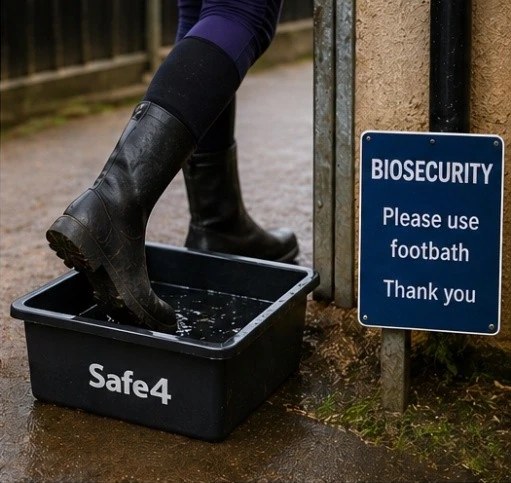
- Keep dedicated boots for each shed or bird area. This is your strongest barrier.
- Brush and scrub off mud and manure before the footbath. Organic matter weakens any disinfectant.
- Make up footbaths with Safe4 Disinfectant Cleaner at 1:10. Change them whenever they’re visibly dirty, and keep them covered from rain.
Vehicles
- Park visitor and delivery vehicles outside the bird area wherever possible.
- Set up a wash-down point at the entrance for wheels, wheel arches and floor mats. Clean with detergent first, then disinfect.
- Keep a log of vehicles and visitors. Your biosecurity plan will ask for records.
Equipment
- Don’t share crates, egg trays, feeders or tools between properties. If you must, clean and disinfect them before they come back on.
- Clean first to remove organic matter, then apply disinfectant and allow the full contact time.
Sheds, between batches and after any scare
|
1
|
Remove birds, litter and manure, and dispose of it all biosecurely. |
|
2
|
Dry-clean, then wash all surfaces with detergent and rinse. |
|
3
|
Disinfect with Safe4 Disinfectant Cleaner at 1:10, allowing 30 minutes’ contact time. This is the tested H5N1 rate. |
|
4
|
Allow surfaces to dry completely before restocking. NZ ACVM requirements say treated surfaces must be dry before animals are exposed to them. |
People
- Wash hands before and after handling birds. Keep sanitiser at every shed door.
- Wash overalls and work clothing separately from household laundry.
- Limit visitors. People who keep birds themselves are a higher risk, not a lower one.
For vets and food businesses
- Treat consult rooms, transport crates and handling areas after seeing birds as you would after any notifiable-disease risk. Follow MPI’s information for vets.
- In receiving and dispatch areas, disinfect returnable crates, trays and pallets before they go back to farms.
Safe4 for avian influenza
Safe4 advises that Safe4 Disinfectant Cleaner Concentrate has been independently efficacy tested against Avian Flu (Virus H5N1) at a 1:10 dilution with a 30-minute contact time. The tests were carried out by the Veterinary Laboratories Agency (VLA) and the Animal and Plant Health Agency (APHA), both agencies of DEFRA, with a pass result.
- DEFRA-approved under the Avian Influenza and Influenza of Avian Origin in Mammals Order, the Diseases of Poultry Order and the Tuberculosis Orders, in all four fragrances.
- MPI approval reference C39 for use with poultry and eggs, and approved for use in MPI Transitional Facilities, including specific use against HPAI.
- Contains no phenols or alcohol. Water-based and biodegradable, with a neutral pH at recommended working dilutions.
Read more: Avian Influenza & Bird Flu Disinfectant
Tested H5N1 rate — sheds, equipment and surfaces1:10 for 30 minutes
Safe4 advises this is the independently tested H5N1 rate (VLA and APHA). MPI approval reference C39. A quick boot dip does not achieve a 30-minute contact time — scrub boots clean first, use a 1:10 footbath, and keep dedicated boots per shed. |
A one-stop biosecurity kit
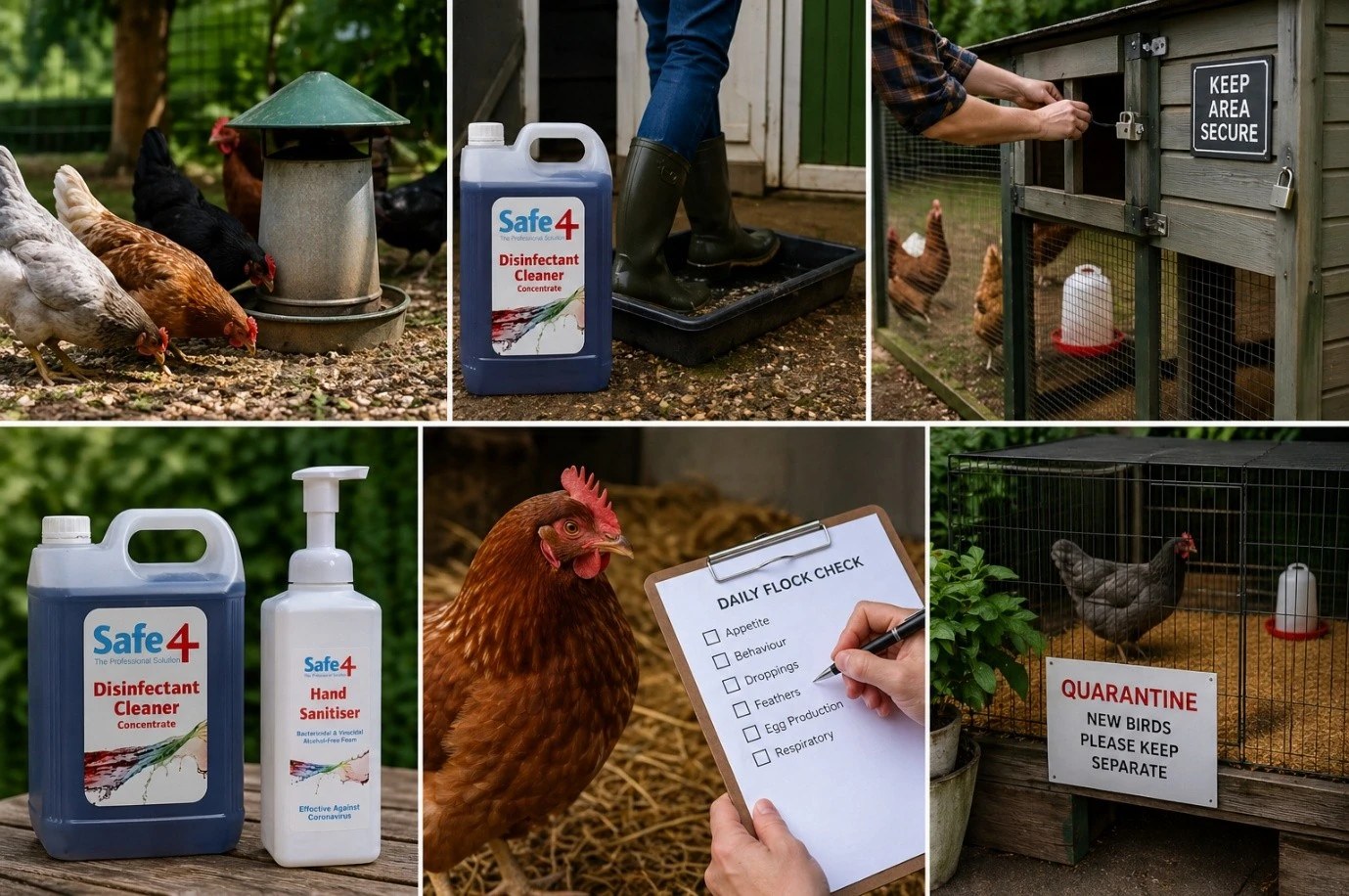
- Disinfectant Cleaner for sheds, equipment, vehicles and footbaths
- Mixing Station for accurate 1:10 dilutions, every time
- Bactericidal Hand Wash for handwashing at shed entries
- Foam Sanitiser (alcohol free) for hands between sheds
- Laundry Liquid for overalls and work clothing
For commercial quantities, or help choosing the right product and dilution for your operation, contact us.
Shop Safe4 Disinfectant Cleaner
Order the 5 Litre Duo concentrate — a practical size for flocks of every size — or browse the full range.
Ngā mihi,
Chris Vere
Director, Safe4 ALL NZ
www.safe4all.co.nz | 4info@safe4all.co.nz | 0800 723 347
Sources
- Ministry for Primary Industries, Don’t let bird flu take flight: mpi.govt.nz
- RNZ, More than 3000 bird flu tests carried out since July (19 November 2026): rnz.co.nz
- Department of Conservation, H5 bird flu Q&As (updated 11 November 2026): doc.govt.nz
- Egg Producers Federation, Media Statement: Poultry sector gets stronger biosecurity backing to fight bird flu (Hon Andrew Hoggard, 28 July 2026): eggfarmers.org.nz
- Self-declaration of country freedom from HPAI by New Zealand (September 2025): woah.org
- RNZ, Controls lifted at Otago poultry farm after high pathogenic bird flu eradicated (28 April 2025): rnz.co.nz
- birdflu.co.nz, Protect your flock (quotes the ministers’ release of 17 July 2026): birdflu.co.nz
- Safe4 NZ, Avian Influenza & Bird Flu Disinfectant: safe4all.co.nz
This article gives general biosecurity guidance. Biosecurity New Zealand’s advice is the official advice to follow. If you suspect bird flu, call 0800 80 99 66.